Entity audit & disambiguation
How machines currently resolve you: name collisions, competitor confusion, stale facts, and orphaned profiles. The gap between who you are and what the graph says.
Entity SEO & Optimization
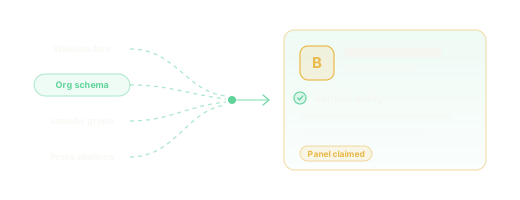
Entity SEO is the work of turning your brand from a string of keywords into a thing machines recognize: one canonical record of who you are, what you do, and who vouches for it. That record is what Google renders as a knowledge panel and what AI engines ground their answers in. We build it deliberately: Wikidata, structured data, sameAs graphs, and the corroborating citations that make machines agree on one version of you.
Why it matters now
When AI Mode, ChatGPT, or Perplexity decides whether to recommend you, it resolves you as an entity before it reads a single page: who is this brand, what category does it belong to, who corroborates that. Google made the stakes explicit in 2026 by deleting roughly 3 billion weak entities from its Knowledge Graph so the survivors could serve as grounding data for AI Overviews and AI Mode. Brands with a clean, corroborated entity graph get named accurately and cited confidently. Brands without one get paraphrased, confused with competitors, or skipped. This is the deepest-moat work in GEO: slow to build, brutal for competitors to displace.
A Wikidata item with sourced claims, organization schema on your domain, and consistent identifiers. The single canonical record every other surface points back to.
Profiles, directories, press bios, and registries brought into exact agreement: same name, same facts, same category. Machines trust what independent surfaces repeat identically.
Entities drift, facts go stale, and bad edits happen. Google's 2026 purge proved that unmaintained records get culled. Ongoing monitoring keeps the graph accurate and alive.
What's included
How machines currently resolve you: name collisions, competitor confusion, stale facts, and orphaned profiles. The gap between who you are and what the graph says.
A properly sourced, notability-appropriate Wikidata item with verifiable claims. No spam edits, no puffery: items built to survive editor review, because reverted edits set you back months.
Organization, Person, and Brand markup with a complete sameAs web linking every legitimate profile. The machine-readable assertion of identity, deployed on your domain.
The independent citations that make the claims stick: press bios, industry registries, speaker profiles, and directory records, aligned word for word.
Once eligibility signals are in place, we work the triggering process and claim the panel so you control updates. Founders and executives get the same treatment as the brand where it pays.
Monthly checks on the panel, the Wikidata item, and how ChatGPT, Perplexity, and AI Mode describe you. Drift gets corrected before it propagates into answers.
How the work runs
Audit how every machine surface currently sees you. Naming conflicts and contradictions get fixed before anything new gets built on top of them.
Wikidata, schema, and the sameAs graph go live as one consistent assertion of who you are, sourced well enough to survive scrutiny.
Independent surfaces brought into alignment, citation by citation. This is the slow part, and the part competitors can't shortcut either.
Panel eligibility worked until it renders, ownership claimed, and the record monitored monthly so it stays true across Google and the LLMs.
Client Outcome
From the results library: measured performance across a full engagement window.
Read the full story“Six months ago, searching our name returned everything except us. Now the category searches bring us discovery calls, and the compounding is visible week over week.”
Straight answers
No sales spin. If the honest answer is "it depends," we tell you what it depends on.
Keep exploring
Ready when you are
Free entity audit: how Google and the LLMs currently identify you, where the record contradicts itself, and the shortest path to an entity that's actually yours.
Get a free entity audit