Knowledge inventory & concept mapping
A structured audit of everything your organization can claim, teach, or prove, broken into the discrete concepts a bundle is built from.
OKF Creation
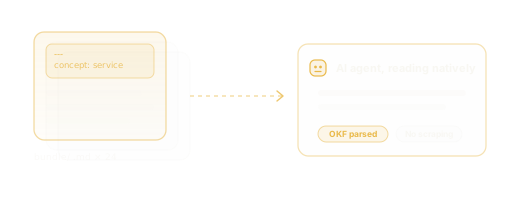
The Open Knowledge Format, published into the Google Cloud ecosystem in June 2026, packages what your organization knows as structured markdown bundles: one concept per file, YAML facts on top, human explanation below. Agents parse it directly instead of scraping your site and guessing. We inventory your knowledge, author the bundle, and keep it in sync. Almost nobody offers this yet. That's precisely the point.
Why it matters now
The next buyer research loop isn't a person typing queries; it's their AI agent gathering facts to compare options. Agents work best with structured, declared knowledge, and OKF is the first open format built for exactly that handoff. Nothing crawls the open web for bundles yet, and honest practitioners admit it. But formats reward the early: the brands whose knowledge is already structured when agent traffic arrives get read first, and structuring your knowledge now costs a sprint. Retrofitting it under pressure later costs a quarter.
Services, products, methods, pricing logic, FAQs, and proof points inventoried as discrete concepts. Most organizations have never listed what they know; the inventory alone sharpens every other channel.
One concept per file: YAML frontmatter carrying the machine-checkable facts, markdown body carrying the explanation. Written to the current spec, validated, and versioned.
The bundle deployed on your domain, tied into llms.txt and your schema layer, and updated when your facts change. A stale knowledge file is worse than none.
What's included
A structured audit of everything your organization can claim, teach, or prove, broken into the discrete concepts a bundle is built from.
Every concept file written to spec: clean frontmatter, accurate claims, readable explanations. Authored by people who write for machines daily, not exported by a script.
Bundle claims kept consistent with your schema markup, Wikidata item, and site copy. Machines cross-check; contradictions cost trust everywhere at once.
The bundle deployed on your domain with discovery signals in place: llms.txt reference, sitemap inclusion, and clean URLs agents can fetch.
A lightweight process tying bundle updates to your content calendar, so new services, prices, and proof points land in the bundle the week they change.
The format is weeks old and will evolve. We track the spec and migrate your bundle as it matures, so the early bet stays current.
How the work runs
Workshops and content mining produce the concept map: what you know, what you can prove, and what an agent would need to recommend you.
Concept files drafted, fact-checked against your actual offering, and validated against the spec. You review every claim before it ships.
The bundle goes live on your domain, referenced from llms.txt and aligned with your schema, ready for whatever starts crawling first.
Facts stay current through the sync workflow; the format stays current through spec-watch. The bundle ages like infrastructure, not like a campaign.
Client Outcome
From the results library: measured performance across a full engagement window.
Read the full story“We used to be invisible unless someone typed our name. Now we get found by people who didn't know we existed. The enquiries come in already knowing what class they want.”
Straight answers
No sales spin. If the honest answer is "it depends," we tell you what it depends on.
Ready when you are
Free scoping call: what your bundle would contain, what it costs to build, and an honest read on whether you should do it now or fix deeper layers first.
Scope your OKF bundle