Full technical audit
Crawl analysis, indexation, canonicals, redirects, duplicate content, and log-level crawl behavior, every issue scored by visibility impact. The classic audit, plus an AI-crawler pass most audits skip entirely.
Technical GEO
GPTBot, PerplexityBot, and ClaudeBot don't render JavaScript the way a browser does. If your content lives behind client-side rendering, slow responses, or missing structured data, you're invisible to the engines your buyers ask. Technical GEO is the full technical SEO discipline, crawl, index, Core Web Vitals, schema, plus the machine-readability layer AI retrieval depends on. We find what's broken, rank it by impact, and fix it.
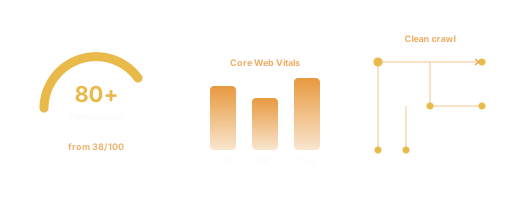
Why it matters now
Every layer of visibility depends on machines reaching, rendering, and understanding your site, and the machines multiplied. Googlebot renders JavaScript; most AI crawlers don't. Google reads your schema; LLM retrieval leans on clean HTML and fast responses. A site that passes a classic technical audit can still be unreadable to the engines that write the answers. That gap is where Technical GEO lives, and almost nobody audits for it.
Robots directives, AI crawler access, llms.txt guidance, sitemaps, and canonical strategy. GPTBot blocked in robots.txt by a years-old copy-paste is a real finding we make weekly.
SSR or ISR on content templates, Core Web Vitals to threshold, and clean HTML that survives a no-JavaScript fetch. What the crawler receives is what you get cited from.
Schema across every critical type, coherent heading structure, dateModified freshness signals, and canonicals that agree with each other. The machine-readable version of your site, complete.
What's included
Crawl analysis, indexation, canonicals, redirects, duplicate content, and log-level crawl behavior, every issue scored by visibility impact. The classic audit, plus an AI-crawler pass most audits skip entirely.
Robots and firewall rules verified for GPTBot, PerplexityBot, ClaudeBot, and Google-Extended, with llms.txt deployed to guide what they read first.
Client-side content moved to SSR or ISR on the templates that matter, so crawlers that don't execute JavaScript still receive the full page.
LCP, INP, and CLS diagnosed and fixed against field data: image pipelines, render-blocking resources, server response, caching. Speed is a retrieval signal too.
Organization, Article, FAQ, Product, Breadcrumb, and HowTo implemented and validated site-wide, templated so every new page inherits the layer.
Continuous checks on indexation, performance, and crawler access. We once caught broken canonicals across an entire blog library within 24 hours of deployment. That's the standard.
How the work runs
Full-site crawl, Search Console deep-dive, field-data review, and a no-JavaScript fetch of every key template. You see exactly what each engine can and can't read.
Whatever locks pages out of an index or a retrieval pipeline goes first: blocked crawlers, render failures, canonical chains. Movement here shows fastest.
Schema, architecture, internal linking, and freshness signals, built to hold at template level so fixes compound instead of eroding.
One deploy can undo a quarter of fixes. Continuous monitoring catches regressions in hours, not in next quarter's traffic report.
Client Outcome
From the results library: measured performance across a full engagement window.
Read the full story“The numbers moved at a scale our paid team noticed. Organic is now a line item in acquisition planning, not a footnote.”
Straight answers
No sales spin. If the honest answer is "it depends," we tell you what it depends on.
Keep exploring
Ready when you are
Free technical audit: a no-JavaScript fetch of your key pages, AI crawler access check, Core Web Vitals, and schema gaps, scored by impact with the fix order laid out.
Get a free technical audit