- Anchor text is the clickable words of a link. Engines read it as a hint about the linked page.
- There are six types: branded, naked URL, generic, partial-match, exact-match, and image anchors.
- Keep the mix natural: mostly branded and natural anchors, exact-match well under 10%.
- Over-optimized anchors (too many exact-match keywords) are a clear spam signal.
- You control internal-link anchors fully, so use descriptive, varied phrasing.
If you have read anything about backlinks, you have seen the phrase anchor text. It sounds technical, but the idea is simple, and getting it slightly wrong is one of the easiest ways to make a link profile look manipulative. This guide explains what anchor text is, the six types with examples, a safe distribution, and how it fits into the bigger job of building backlinks.
The short answer: anchor text is the visible, clickable words of a hyperlink. Search engines use it as a hint about what the linked page is about. Keep your anchor profile natural, mostly branded and descriptive, and use exact-match keyword anchors sparingly, because too many of them look like manipulation.
What Is Anchor Text?
Anchor text is the clickable text of a link. In the sentence "learn how to build backlinks," the words "build backlinks" are the anchor. When a page links to you, the anchor text it uses tells search engines something about your page, which is why anchors carry a small but real ranking signal.
The catch is that you do not control the anchors on your backlinks; the linking site does. What you can control is the overall pattern by choosing which links to pursue and how you request them, plus the anchors on your own internal links.
The 6 Types of Anchor Text
Every anchor falls into one of six buckets. A healthy profile uses a natural spread across them rather than leaning hard on any single type.
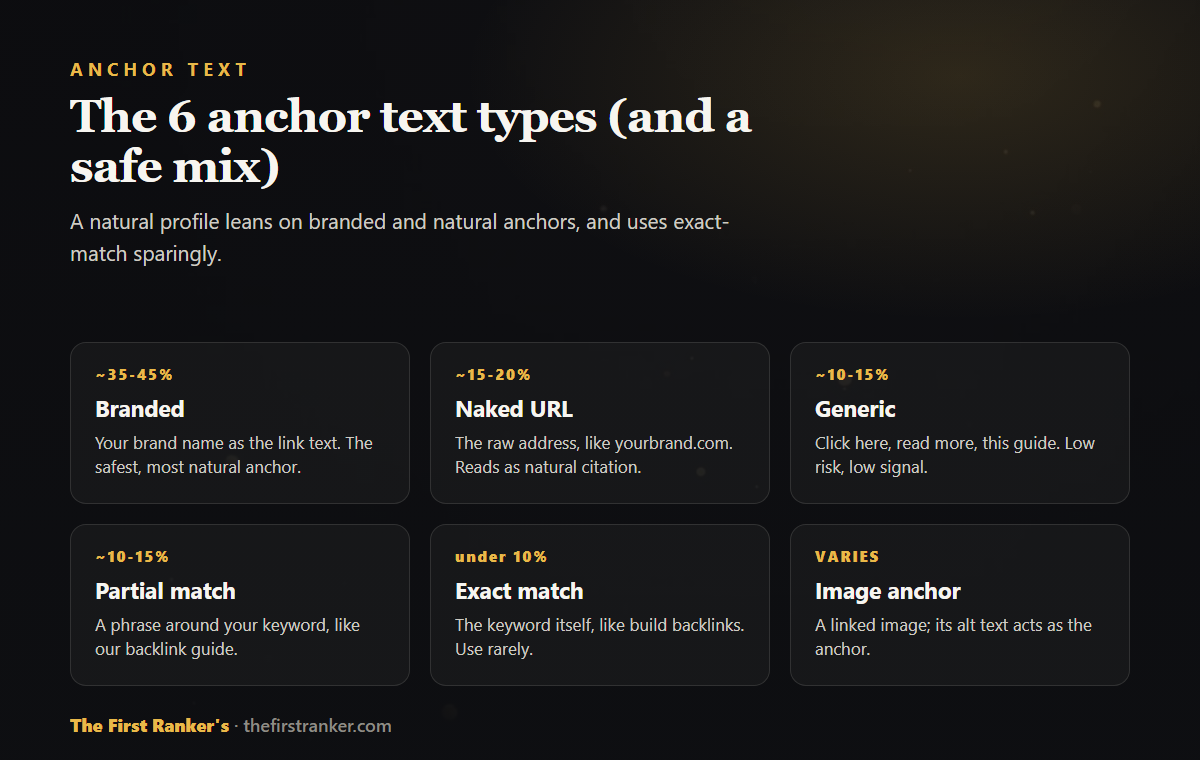
- Branded: your brand name as the link text. The safest and most common anchor in a natural profile.
- Naked URL: the raw address, like yourbrand.com. Reads as a straightforward citation.
- Generic: phrases like "click here," "read more," or "this guide." Low risk and low signal.
- Partial-match: a phrase that includes your keyword loosely, like "our backlink guide."
- Exact-match: the target keyword itself, like "build backlinks." Powerful but easy to overuse.
- Image anchor: a linked image, where the image's alt text acts as the anchor.
What Is a Safe Anchor Text Ratio?
There is no official ratio, but the principle is consistency with how real links form. People mostly link with your brand name, your URL, or casual phrasing, so a profile that looks like that reads as earned. A profile stuffed with the exact keyword you want to rank for reads as engineered.
As a working guardrail, keep exact-match anchors well under 10% of your profile and let branded and natural anchors dominate. If your exact-match share creeps up, you are drifting toward over-optimization, which is one of the clearest link-based spam signals there is. If you have inherited a skewed profile, our guide to toxic backlinks and backlink audits shows how to assess it.
Where Anchor Text Fits in Link Building
Anchor text is one attribute of a good link, not the whole story. When you weigh any backlink, you look at relevance, authority, anchor text, and placement together. Chasing a specific anchor while ignoring relevance is how sites over-optimize. For the full picture, see the backlink building playbook, and to find niche-fit places to earn links, try our free backlink finder.
Anchor Text and AI Citations
AI answer engines weigh brand mentions and citations, not just anchor-rich links, when they decide who to trust. That actually reinforces the case for natural anchors: branded mentions and citations from relevant, trusted sites feed both traditional rankings and AI answers. If you want the deeper argument on how links and mentions work together now, read whether backlinks still matter in the AI era.
Frequently Asked Questions
Anchor text is the visible, clickable words of a link. In the sentence "read our backlink guide," the words "backlink guide" are the anchor if they carry the link. Search engines use it as a hint about what the linked page is about, so the words you choose send a small ranking signal.
A natural profile is mostly branded and natural anchors, with exact-match kept small. A common safe mix is roughly 35 to 45% branded, 15 to 20% naked URLs, 10 to 15% each for generic and partial-match, and under 10% exact-match. Treat these as guardrails, not exact quotas; the goal is a profile that looks earned, not engineered.
Not in small amounts. An occasional exact-match anchor is fine and even useful; the problem is over-reliance. When a large share of your links use the same keyword anchor, it looks manipulative and can trigger a spam signal. Keep exact-match well under 10% of your profile.
It is a link profile with an unnaturally high share of keyword-rich exact-match anchors. Real links people give you use your brand, your URL, or casual phrasing, so a profile stuffed with the exact keyword you want to rank for stands out as engineered. That pattern is one of the clearest link-based spam signals.
Yes, as one signal among many. Google still reads anchor text as a relevance hint, and a natural anchor mix is part of a healthy backlink profile. It is not something to obsess over on every link, but a profile skewed toward exact-match keywords still invites trouble.
Internal links give you more freedom than backlinks because you control them. Use descriptive, natural phrasing that tells readers and engines what the target page covers, and vary it rather than repeating the identical keyword everywhere. Descriptive internal anchors also help engines understand your site structure.
The Bottom Line
Anchor text is simple once you see it: the clickable words of a link, read by engines as a relevance hint. Use the six types naturally, keep exact-match anchors rare, and vary your internal-link anchors. Get that right and anchor text quietly supports your rankings instead of quietly sabotaging them.